
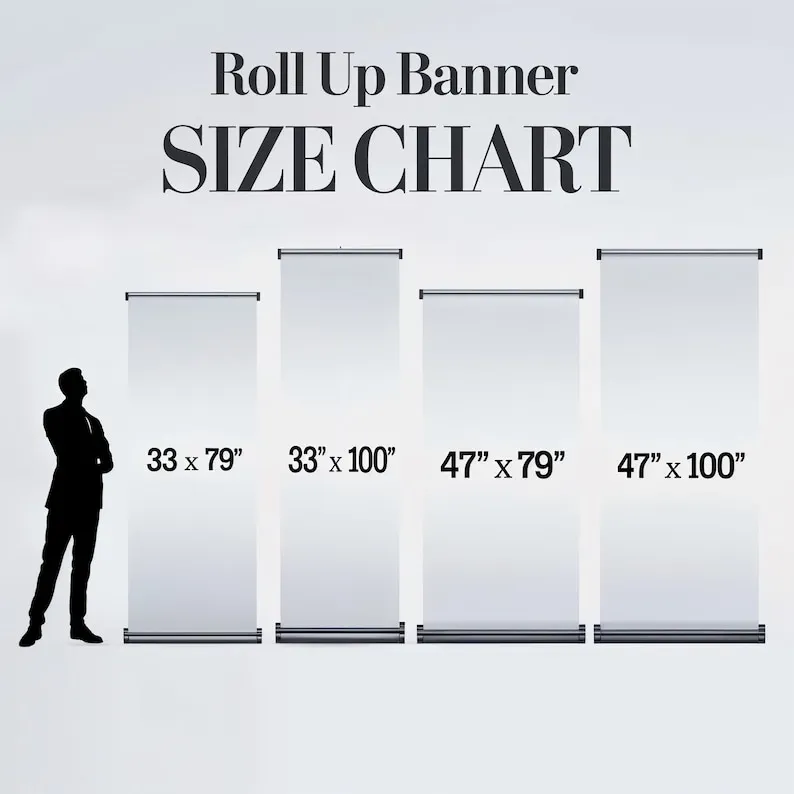
Choosing the right custom roll up banner size is crucial for grabbing attention, conveying your message, and maximizing your display’s impact. To navigate options confidently, consult a custom roll up banner size guide that translates space, distance, and branding into a practical choice. If you’re unsure how to select, consider how to choose roll up banner size by factoring booth dimensions, audience reach, and the balance between image and text. Review the standard roll up banner dimensions and banner stand size recommendations to compare portability, setup time, and visual prominence. For trade shows, the right roll up banner dimensions for trade shows ensure visibility in crowded aisles and effective signage that reinforces your brand.
Understanding the [custom roll up banner size]: Key Factors and Space Considerations
Choosing the right custom roll up banner size begins with a clear sense of space, viewing distance, and audience flow. The size you pick influences how quickly passersby notice your message and how comfortably your copy reads at a glance. In busy environments, a miscalibrated size can make branding feel overpowering or, conversely, barely legible.
To navigate this, refer to a [custom roll up banner size] guide that aligns with your venue type. Start by measuring booth width, aisle width, and sightlines from common attendee approaches, then translate those measurements into one or two target sizes that maximize impact without sacrificing portability. By anchoring decisions in space and distance, you set the stage for an effective display.
Standard Roll Up Banner Dimensions: Common Widths, Heights, and Use Cases
Standard roll up banner dimensions recur across many events because they strike a balance between visibility and portability. The 33-inch-wide option (approximately 84 cm) is typically around 78–80 inches tall (198–203 cm), providing a bold branding canvas that’s easy to transport and set up for retail displays and compact booths.
A 34–36 inch wide variant (roughly 86–91 cm) expands the message area for larger booths while remaining manageable. Taller configurations, such as 33–36 inch widths with 80–86 inch heights, can fill more vertical space when backdrops or banner walls are needed. For constrained spaces, a compact 24–28 inch banner can serve as secondary signage or a digital banner stand substitute, with careful typography and a concise message. When planning, consult banner stand size recommendations to ensure hardware compatibility.
How to Choose Roll Up Banner Size: A Step-by-Step Guide for Different Venues
How to choose roll up banner size involves a simple step-by-step approach: 1) assess your space, 2) determine viewing distance, 3) evaluate content density, 4) factor branding needs, and 5) plan for travel. This framework helps you pick a size that balances readability with portability.
Apply these steps to real venues: for trade shows and conferences where attendees view from mid-range distances, a taller, wider banner often yields better legibility, while in tight booths, a narrower option with concise messaging may perform best. If in doubt, start with a standard size and adjust after testing readability from typical vantage points. Consider also the concept of roll up banner dimensions for trade shows to ensure your choice supports quick recognition from a distance.
Roll Up Banner Dimensions for Trade Shows: Maximize Visibility in Busy Booths
On the trade show floor, use roll up banner dimensions that deliver quick impact: bold typography, high-contrast imagery, and minimal content. This approach leverages large, legible headlines and strong color contrast to capture attention as attendees move through crowded aisles, reflecting the phrase roll up banner dimensions for trade shows.
Place the main banner at eye level near the booth entry and supplement it with additional signs at varying heights to create multiple reading angles. Align visuals with banner stand size recommendations to maintain a cohesive display that reads well from several meters away and remains easy to transport between venues.
Banner Stand Size Recommendations: Matching Width, Height, and Stand Compatibility
Banner stand size recommendations should guide the printed width and height so the finished banner aligns with your stand’s rails, stops, and rolling mechanism. A mismatch can cause creases or gaps and reduce the perceived quality of your display.
Always verify compatibility with your stand hardware before ordering prints. If you frequently switch venues, choose sizes that fit standard stands and keep spare panels for quick swaps. Consistent sizing across materials helps streamline setup and reconfiguration.
Design, Printing, and Setup Tips for Different Banner Sizes
Design and printing respect the chosen size by preparing artwork at 300 DPI, using vector logos where possible, and including bleeds and safe margins. This ensures sharp text and clean imagery at actual size, even when printed on vinyl or mesh substrates.
Test readability from the target distance in a setup that mimics the event environment. Consider outdoor or bright venues that may require weatherproof inks or mesh to reduce light transmission, and plan for safe handling, storage, and a reliable roll-up mechanism to prevent surprises during install.
Frequently Asked Questions
What is the best custom roll up banner size for a small trade show booth according to the custom roll up banner size guide?
For compact booths, a 33-inch-wide banner (about 84 cm) with a height around 78–80 inches (198–203 cm) is a popular choice. It provides ample branding space, is easy to transport, and stays readable at typical trade show distances. If space allows, a 34–36 inch wide option can offer a broader message area while maintaining legibility. Always consider the safe viewing zone and place your key message around 60–70 inches from the floor.
How to choose roll up banner size for a conference display using the how to choose roll up banner size framework?
Start by measuring the display space and assessing how far attendees will be from the banner. For close viewing (1–3 meters), a tighter 33″ width with bolder typography works well; for mid-to-far viewing (5–10 meters), a taller and slightly wider 34–36″ option improves legibility. Balance content density, branding, and transport practicality. Follow the steps in how to choose roll up banner size for a structured approach.
What are the standard roll up banner dimensions and how do they fit a busy trade show floor?
Standard roll up banner dimensions usually include a 33-inch width (approximately 84 cm) with heights around 78–80 inches (198–203 cm). A 34–36 inch width (approximately 86–91 cm) version is common for larger booths. On busy floors, prioritize high-contrast typography, a concise headline, and a prominent logo to maximize visibility from about 2–3 meters away.
What banner stand size recommendations should I consider when planning a banner wall for an event?
Choose widths that fit your space: 33″ or 34–36″ banners are typical starting points. For a banner wall, you may combine multiple banners or use a taller unit (80–86 inches) to fill vertical space. Ensure the stand width matches the banner and that you can transport and assemble easily with a protective case.
How should I evaluate roll up banner dimensions for trade shows to maximize impact?
Evaluate space, viewing distance, content density, and branding. Position the most important message at about 60–70 inches from the floor for visibility. Use large, high-contrast typography and limit the amount of text. Test readability from a few meters away and ensure safe margins.
What printing and material tips align with the custom roll up banner size guide to ensure durability?
Design at 300 DPI, prefer vector logos, include a 1/8 inch (3 mm) bleed, and keep critical content 6 mm from edges. Choose vinyl for durability or mesh when wind or light transmission is a concern. Confirm banner width compatibility with your stand, and use a protective case for transport.
| Point | Key Details | Notes |
|---|---|---|
| Why size matters | Attract attention, communicate message, maximize display value; size influences reader notice and understanding | Applicable to trade shows, conferences, storefront events, in-store promotions |
| Risks of incorrect size | Small may look underwhelming; large can feel overwhelming or be hard to transport | |
| What you’ll gain | Clear approach to selecting size; understand common sizes; design tips; printing/setup considerations | From this guide; practical steps explained |
| Space and audience importance | Size decisions start with space and viewing distance; balance prominence with legibility | Distance influences width, height, and typography choices |
| Safe viewing zone | Most important message positioned around 60–70 inches (152–178 cm) from the ground | |
| 33-inch wide option | Width ~84 cm; height ~78–80 inches (198–203 cm); portable and versatile | Popular for retail displays, small trade booths; easy transport |
| 34–36 inch wide option | Width ~86–91 cm; height similar; broader message area | Good for larger booths; keeps readability at eye level |
| Tall or backdrops | 33–36 inch width with 80–86 inch height for more vertical space | Suitable for logos and taglines at mid-distance |
| Compact option | 24–28 inch wide banner; portable; suitable as digital stand substitute | Requires strong typography and concise messaging |
| Decision steps | Assess space, viewing distance, content density, branding needs, travel/setup | Follow a structured five-step evaluation |
| Design & layout considerations | Prioritize headline; use large, legible typography; limit color palette; include a clear CTA; leverage negative space; align with brand guidelines | Test readability from target distances; ensure branding consistency |
| Printing & materials tips | Design at 300 DPI; vector logos; bleed and margins; choose vinyl or mesh; proper finishing | Consider lighting and venue to maximize visibility |
| Usage tips by event | Trade shows, conferences, retail promotions, and outdoor events require size and material choices aligned with context | Place strategically; match signage with branding; outdoor requires durable materials |
| Common mistakes | Overloading design; narrow typography; inconsistent branding; ignoring safe margins | Keep content focused and legible |
Summary
Choosing the right custom roll up banner size shapes visibility, readability, and overall impact at events. This topic aligns with a roll up banner size guide, referencing standard roll up banner dimensions and the right banner stand size for your venue. By balancing space, audience distance, and clear messaging, you create a durable, portable display that reinforces your brand. With careful selection of the custom roll up banner size, your banner becomes a confident ambassador for your brand across trade shows, conferences, and retail environments.